Collective Activation
Design an engagement that activates collective action and engagement.
After forming our artist/designer collective, we will design an engagement that activates collective action and engagement. This project is an opportunity to experiment with how we can use design to foster connection, participation, and collective action. The engagement you design should be rooted in the values and intentions of your collective, and should encourage others to participate in a meaningful way.
The project is in 5 parts.
 Image from Guerrilla Girls
1–Urgent Topics
Are there specific issues or causes that your collective is passionate about? Maybe there are issues that you have been personally affected by, or that you have seen others in your community affected by. Consider how you can design an engagement that addresses these issues and encourages others to take action.
You don’t have to ALL work on the same engagement. It’s common for collectives to have different projects that are all connected by a common thread. You can choose to work on the same engagement or different engagements, as long as they are all aligned with the values and intentions of your collective.
For example, if your collective is passionate about environmental justice, you could each design different engagements that address different aspects of environmental justice, such as climate change, pollution, or access to green spaces. As long as you are all working together to support each other and amplify each other’s work, you can have different engagements that are all connected by a common thread.
2–Design Action
How can you design an engagement that encourages others to take action on these issues? It can be a workshop, a small gathering, a public intervention, a digital campaign, or any other form of engagement that you think would be effective in activating collective action.
Consider alternative ways to engage people beyond traditional methods, for example, walking tours, conversations, games, or other interactive formats. Think about how you can create an experience that is engaging, inclusive, and accessible to a wide range of people.
When designing your engagement, consider how you can make it accessible and inclusive for a diverse range of participants. Think about the different ways people might want to engage with your project, and design for those different modes of participation. Consider how you can create a welcoming and supportive environment that encourages people to participate and feel like they belong.
3-Infra-structure
What kind of infrastructure do you need to support your engagement? Consider the resources, tools, and support you need to design and execute your engagement. Think about how you can build infrastructure that supports your collective and sustains your work over time.
Survey and research what spaces, resources, tools and support you have access to and how you can leverage those to support your engagement. If you need additional resources, think about how you can build partnerships or collaborations with other organizations or collectives that can provide the support you need.
Bring these reflections to class to share with your peers and get feedback on your ideas. We will also discuss how to build infrastructure to support your engagement and sustain it over time, and look at examples of artists’ labor movements and how they have fought for fair compensation and better working conditions. This will be an opportunity to learn from the experiences of others and think about how you can apply those lessons to your own work.
4–Document the Process
How can you document your process and the impact of your engagement? Consider how you can use different forms of documentation, such as photos, videos, written reflections, or social media posts, to capture the experience and share it with others. Think about how you can use documentation not only to share the impact of your engagement, but also to reflect on the process and learn from it.
If you’re creating an online experience, will you create a specific hashtag for people to share their experiences? If it’s a public engagement, will you record a timelapse video of the event? If it’s a workshop, will you create a zine or booklet that captures the key takeaways and reflections from the participants? Consider how you can use documentation to amplify the impact of your engagement and inspire others to take action.
5–Reflection
After your engagement, take some time to reflect on the experience as a collective. What worked well? What could have been improved? What did you learn from the process? Focus on the collective experience and the impact of your engagement, rather than individual contributions.
Think about the ways of working that you established in your collective proposal, and how they played out in the process of designing and executing your engagement. Consider how you supported each other and held each other accountable to your shared values and commitments. Is this a way of working that you want to continue in future projects? Is this time-consuming? Is this sustainable? What adjustments might you want to make for future projects?
Is there anything we wish to revise in our manifesto or ways of working based on this experience? How can we use this experience to inform our future projects and collective work?
Research Collectives
We will spend the first week researching other collectives and how they build infrastructure to support their work and sustain themselves.
This assignment is originally designed by Professor Asad Pervaiz and Tyler Paige. The list of collectives and language has been revised here.
For this assignment, you will work in group to research and analyze a collective that you find interesting, and prepare a 5-page slides to introduce the collective to your peers. You can choose any collective that you find interesting, but it should be relevant to the themes and topics we have discussed in class. Some examples of collectives include artist collectives, design collectives, activist collectives, and worker cooperatives.
Your slides should include the following information:
- An introduction to the collective and its mission.
- A brief history of the collective and its key members.
- An analysis of the collective’s work and its impact on its community or industry.
- A discussion of the collective’s organizational structure and how it sustains itself financially.
- A reflection on what you learned from researching this collective and how it relates to the themes we’ve discussed in class.
Here are a list of collectives that you can choose from, but feel free to research and choose other collectives that you find interesting:
- ACT UP
- AfriCOBRA
- Ant Farm
- Arab Image Foundation
- Art Club 2000
- Assemble
- Basement Workshop
- BFAMFAPhD
- Black Audio Film Collective
- Bruce High Quality Foundation
- Camel Collective
- Center for Urban Pedagogy
- Critical Art Ensemble
- Design Action Collective
- Dexter Sinister
- DIS
- Double Fly Art Center
- Epoxy Art Group
- Fierce Pussy
- Forensic Architecture
- GCC
- General Idea
- Group Material
- Guerrilla Girls
- Gutai Art Association
- House of Ladosha
- Institute for Queer Ecology
- Interference Archive
- Justseeds Artists’ Cooperative
- K-HOLE
- M12
- Madame Binh Graphics Collective
- Metahaven
- My Barbarian
- Myvillages
- New Red Order
- Okay Mountain
- O-R-G
- Partner & Partners
- Pond Society
- Press Press
- Public Movement
- Pussy Riot
- Radix Printing & Publishing Cooperative
- Raqs Media Collective
- Red Sun Press
- Room 4 Resistance
- Ruangrupa
- Shanzhai Biennial
- Superflex
- Temporary Services
- The Bernadette Corporation
- The Heresies Collective
- The Otolith Group
- The Propeller Group
- The Question of Funding
- The Yes Men
- Ultra-red
- W.A.G.E. (Working Artists and the Greater Economy)
- What, How & for Whom
- Where We At
Collective Proposal
You will work in groups of 3 to create a collective proposal that includes a name, values, manifesto, and individual roles. This proposal will serve as the foundation for your group project and will be shared with the class.
The project is in 4 parts. This assignment is originally designed by Professor kimi malka hanauer. The language has been revised here.
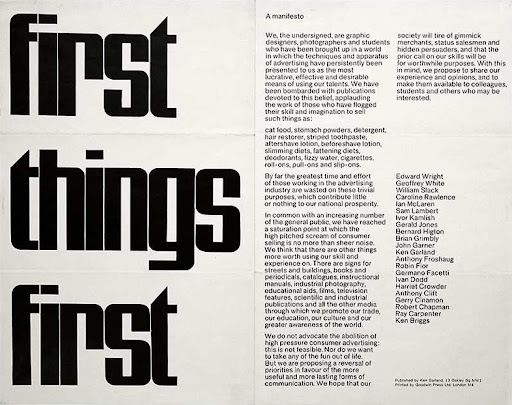 Image from First thing first manifesto
1–Collective Name
- What is the name of your collective? Consider that while developing a name can take some negotiation, how might it reflect the practice and the process of the collective?
- As your name might be the first entry into learning about you, how might this be an opportunity for a potential audience to not only understand what your work is about, but potentially get excited and rally behind in support of your work?
2–Manifesto
- This “written statement” should be considered an outward facing material, a document that can be shared, disseminated, and help others understand the collective intent. This document is not intended to highlight individuals in the collective, rather a common goal shared by the group.
- Your written statement may include examples of systems of oppression and power for which your collective stands to “resist” or “act”. Consider the intersecting positions and contexts your collective perspective emerges through; what actions (can be pragmatic and/or speculative) are you uniquely positioned to enact in the world?
- After formally writing your manifesto, you need to put your manifesto in visual form. This visual form could be a poster, a booklet, a video, a website, anything that seems appropriate for the content of your manifesto. Allow the content of the manifesto to guide your decision as to the physical form of your manifesto.
3–Ways of Working
- What shared commitments guide your collective (e.g., mutual aid, transparency, care, anti-racism, access, experimentation, consent, refusal)?
- For each value, describe what it looks like in practice: how you make decisions, communicate, share labor, handle conflict, and support participation.
- What working agreements will help each member participate at their best (capacity, schedules, boundaries, credit, tools, accessibility needs)?
- How do want to work together? What are some of the ways you can support each other and hold each other accountable to the values and commitments you have outlined? Consider how you can create a culture of care, respect, and collaboration within your collective.
4–Individual Roles
- Before assigning specific individuals to roles, try and define the positions that support the collective endeavor first, and which roles would work in concert with each other. Try to avoid hierarchical relationships, and instead consider that each role holds demonstrative value in this space. Further, as an active collective, individual roles can be defined as active “positions” and not titles.
- Leaning into lessons on implicit and explicit roles, discuss which individuals in the collective may support specific roles. While individuals should always advocate for themselves, consider others, and how each individual can be placed in a position for success. This may take some volunteering, nomination and negotiation. Consider that some individuals may hold multiple roles, and some roles may be held by multiple individuals.
Generosity as a Tool
Design a design artifact based on the concept of generosity as a tool for building community and fostering togetherness.
A community does not need to be permanent. A brief shared situation, such as people gathering, coordinating, or participating in a common gesture, can already constitute a community. When generosity is intentionally designed as a gift, service, or offering, it can give rise to a temporal community that exists through participation.
For this project, you are tasked to design an artifact or structure that enacts generosity through what you can offer others. Your offering should be grounded in your own skills, resources, time, or interests, and should invite others to participate in some way.
Think about what kind of facilitation, object, or gesture you can create that encourages others to engage with your act of generosity. This is a way for others to know you through what role you play in a community context and what you can contribute later when forming a collective.
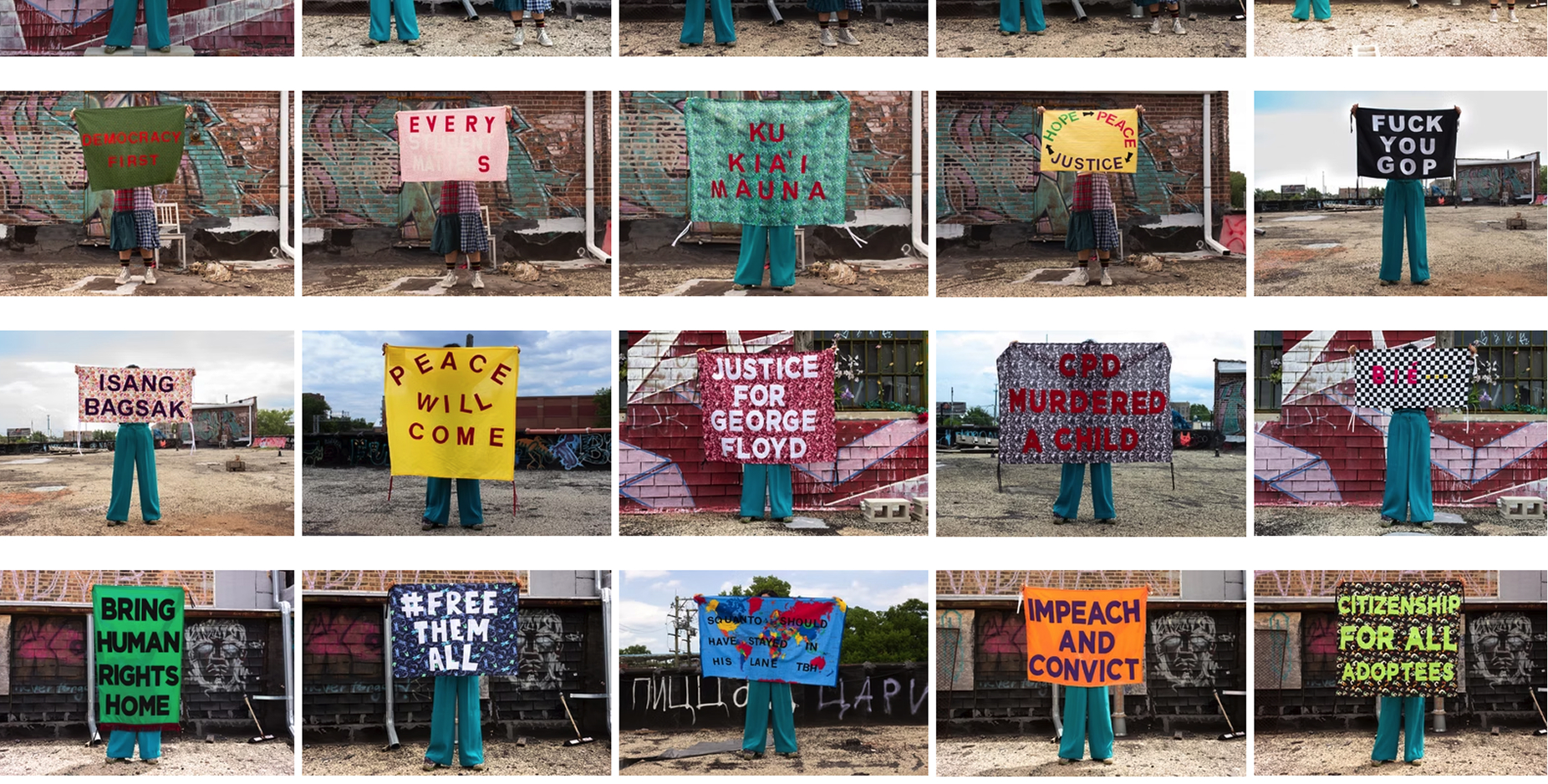 Image from Protest Banner Lending Library by ARAM HAN SIFUENTES
Before starting it:
- Read the THE SOCIAL CHANGE ECOSYSTEM MAP by Deepa Lyer from Building Movement Project.
- Review the different roles outlined in the map and use the guiding questions to reflect on: What roles you often take on in collective or community contexts.
- Consider your skills, tools, access, time, and interests, and think concretely about how these could become an act of generosity. What you are able to offer others at this moment?
- Document this reflection in your personal notebook.
The project needs to:
- Using the concept of a gift, a service, gesture, or structure that manifests as a design.
- The project must include a physical takeaway of some kind element (For example, an object, printed material, kit, or artifact). You will bring this to class to share with your peers.
- The design needs to enact generosity in some way, whether through sharing resources, knowledge, time, or support.
- The project should be feasible to execute within a week and should encourage participation from others.
- Document your process and reflections in your personal notebook.
The reflections you gather in your notebook will serve as source material for your collective processes and personal reflections at the end of the semester, as well as throughout the semester. We will not ask to see your notebook in full as we realize it will be highly personal, but we encourage you to really follow through with this assignment.
This project is adapted from an original assignment by Professor Kelsey Dusenka, you can see their lecture here.
Personal Reflection Notebook
Throughout the semester, you are expected to keep a notebook or one centralized place to house all of the reflection writing, creative processing, in-class activities, and external reading and research notes. You will use your notebook as source material for your group projects as well as your final reflection at the end of the semester.
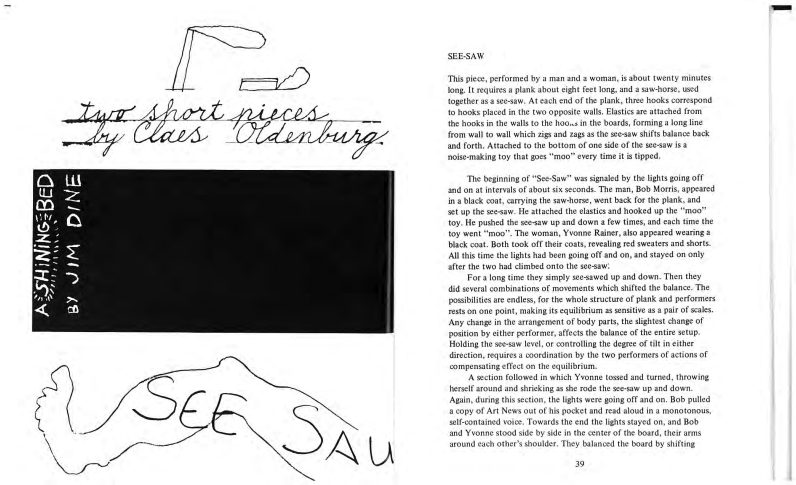 This is a screenshot taken from Simone Forti’s Handbook in Motion, a collection of her dance scores and notes compiled between 1961 and 2008.
Your notebook should aggregate materials such as:
During class time:
- Free writing prompts.
- Workshops and creative activities.
- Discussion notes on readings.
- Discussion notes from group critiques.
- Reflections from the DNVC Workbook (*this work will be conducted both inside & outside of class).
Beyond class time:
After every group collective meeting, you will take 10 minutes to reflect on your experience working in your group. Some questions to consider are included below. Please feel free to pick 1-2 questions that most resonate with you each time you reflect on your group process.
- What shifted for you today?
- What did you learn from others?
- What roles do you find yourself in, intentionally and unintentionally?
- How do you take up space in the group?
- What power dynamics are you observing in the group?
- What conditions and identities contribute to the ways you navigate group work?
- What kinds of situations and conversations make you feel comfort and discomfort?
The reflections you gather in your notebook will serve as source material for your collective processes and personal reflections at the end of the semester, as well as throughout the semester. We will not ask to see your notebook in full as we realize it will be highly personal, but we encourage you to really follow through with this assignment.
Please note: Regardless of if we see this work or not, we will be able to recognize if you are actively reflecting on your experiences within the actual work you produce and the ways you show up in the classroom.